


When parents think of speech therapy, they usually think first of speech — first words, pronunciation of sounds, language development, and communication. However, in children with neurological, motor, and developmental difficulties, what we see in and around the mouth often cannot be fully understood without looking at how the rest of the body functions.
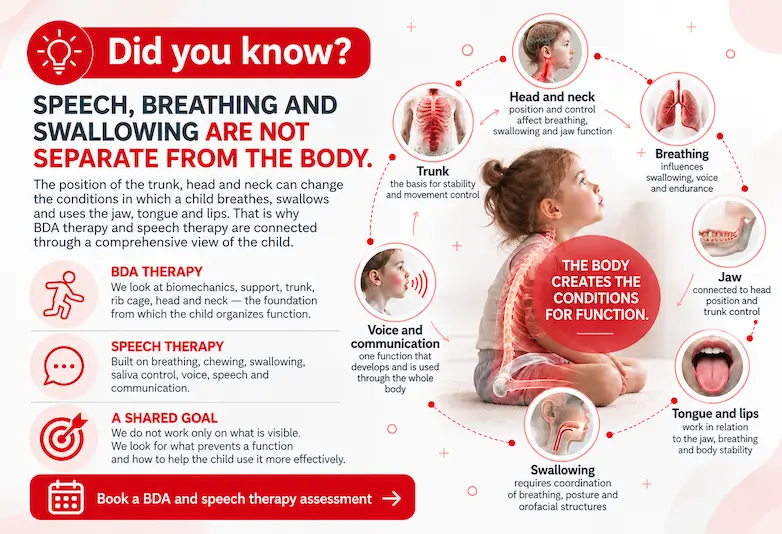
A child does not use the tongue, jaw, and lips independently of the position of the head and neck. Head position is connected to trunk control, while the way a child organizes the trunk and rib cage affects the conditions in which they breathe, swallow, produce voice, and perform other orofacial functions. This is why, at the BDA Center, we brought BDA Therapy and Speech Therapy together.
The idea was not simply to add another service to our existing therapeutic work.
We wanted speech therapy to become part of the same way of understanding the child — not viewing speech, feeding, or swallowing as isolated problems, but trying to understand the physical foundation from which the child is attempting to perform a particular function.
BDA Therapy First Creates the Conditions for Function
In a child who has difficulties with head and trunk control, asymmetry, limited rib cage mobility, or who uses significant extra effort to maintain a position, these factors can affect the conditions in which they breathe, swallow, and use the jaw, tongue, and lips.
This is why, in BDA Therapy, we first look at the body as an interconnected biomechanical system. The assessment helps us understand how the child organizes support, the position of the pelvis and spine, the rib cage, head, and neck, and how load is transferred through the body.
The goal is not to “correct posture” for the sake of posture itself, but to create better conditions from which the child can develop and use a particular function.
This is where we see the foundation for connecting BDA Therapy with Speech Therapy.
If a child uses significant effort simply to maintain head control, if the neck is constantly tense, or if the rib cage has limited ability to adapt during breathing, it is not enough to look only at what is happening in the mouth. We may work on tongue movement or lip closure, but at the same time, we need to understand the physical organization from which the child is trying to perform that movement.
This does not mean that BDA Therapy alone will develop speech, improve swallowing, or resolve a speech therapy-related difficulty. It creates and develops physical conditions that may be important for function, while the speech therapist assesses and works on functions within their professional scope.
For this reason, we do not view BDA Therapy and Speech Therapy as two completely separate processes, but as two professional fields that, for some children, can complement each other.
A Speech Therapist Does Not Look Only at the Mouth
By introducing speech therapy, we wanted to apply the same whole-body approach to the functions addressed by a speech therapist. This means that our speech therapist does not assess only whether a child can produce a particular sound or perform a specific tongue movement. We also look at how the child breathes, swallows, chews, manages saliva, uses the jaw, tongue, and lips, produces voice, and communicates — as well as the position from which the child’s body is attempting to perform all of these functions.
One of the most important functions we observe during this assessment is breathing.
It is not enough simply to note that a child is breathing. We need to understand how the child breathes. Is the breathing calm or shallow? How does the rib cage move? Does the child lift the shoulders or tense the neck when breathing in? Is a significant amount of extra effort required? How does the abdomen move during breathing, and how effectively is the diaphragm involved?
This information becomes particularly important when we connect it with the position of the head, neck, and trunk. A child who needs to use significant additional effort to maintain a position may have different conditions for breathing, swallowing, and orofacial function than a child who has a more stable physical foundation for these functions.
If a Child’s Mouth Is Open, We First Want to Understand Why
An open-mouth posture is a good example of why it is important to connect these two areas. If a child frequently keeps their mouth open, the simplest approach might be to focus on closing the lips. However, simply closing the lips does not tell us why the child keeps their mouth open in the first place.
First, we need to determine whether the appropriate anatomical and functional conditions for nasal breathing are present. When the airways are clear and there is no medical obstruction, we look at the position of the head and neck, the jaw, lip control, breathing pattern, and the child’s overall body organization.
We apply the same principle to other functions. If a child has difficulty managing saliva, we do not look only at the lips. We consider how and how often the child swallows spontaneously, the control of the head and jaw, how the tongue is used, and how the child breathes. If there are difficulties with chewing, we look not only at jaw movement but also at the stability from which that movement needs to occur.
In other words, we do not begin by trying to change what we see. We first try to understand why a particular function is being performed in that way.
Speech Is Not Always the First Goal of Speech Therapy
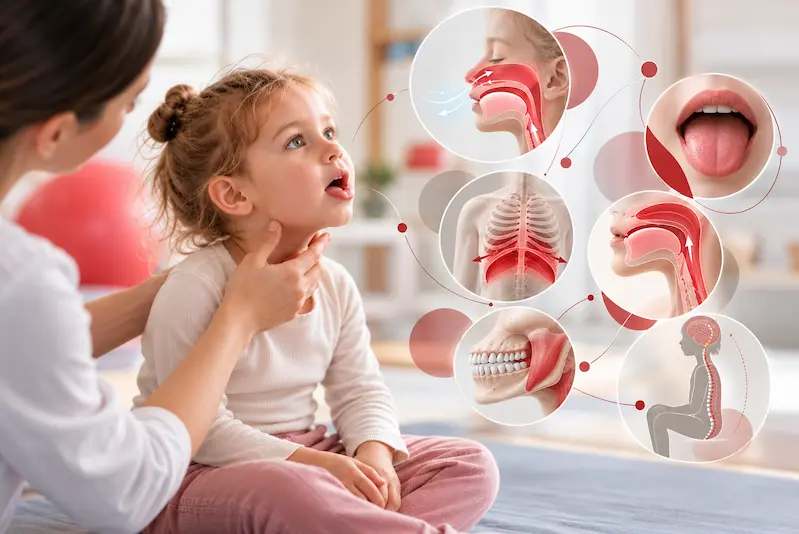
This is particularly important for children with more complex neurological and developmental difficulties. For these children, speech therapy does not necessarily begin with practising speech sounds, nor does speech always need to be the primary goal at that stage.
For one child, the priority may be more effective chewing and better management of food in the mouth. For another, it may be safer swallowing. For a third, the focus may be on more frequent spontaneous swallowing and better saliva control. With some children, we may work on producing a more stable voice, while for others, the goal may be to find a reliable way to communicate, even when spoken language is not available.
This is why we do not start in the same place with every child. The assessment helps us determine which function is currently the priority and what conditions are needed for the child to use that function more effectively.
Why does the speech therapist look at the child’s breathing, head position, and trunk?
Because the functions addressed in speech therapy do not take place only in the mouth. The position of the trunk affects the position of the head and neck, which can change the conditions in which the child breathes, swallows, and uses the jaw, tongue, and lips. This is why, in children with motor and developmental difficulties, it is important to look at the body as a whole.
Why is it not enough to look only at the tongue, jaw, and lips?
Because how they function also depends on the conditions from which the child is performing a particular task. If a child uses significant effort to maintain head control, has an unstable trunk, or uses additional tension during breathing, this can affect how the jaw, tongue, and lips are used. This is why we do not look only at the movement we want to change, but also try to understand what is currently limiting it.
Does a child need to speak in order to benefit from speech therapy?
No. Speech therapy is not focused solely on speech. Depending on the child’s individual needs, the goal may be more effective chewing, safer swallowing, better saliva control, voice production, or the development of a reliable way to communicate. Speech is just one of the functions addressed by a speech therapist.
Why does speech therapy begin before working on speech for some children?
Because sometimes it is necessary to first work on the functions that provide a foundation for later work on voice and speech. For one child, the priority may be breathing; for another, swallowing or chewing; and for another, head control and the conditions from which they use the jaw, tongue, and lips.
The sequence of therapy is therefore determined by each child’s current abilities and individual needs.


