
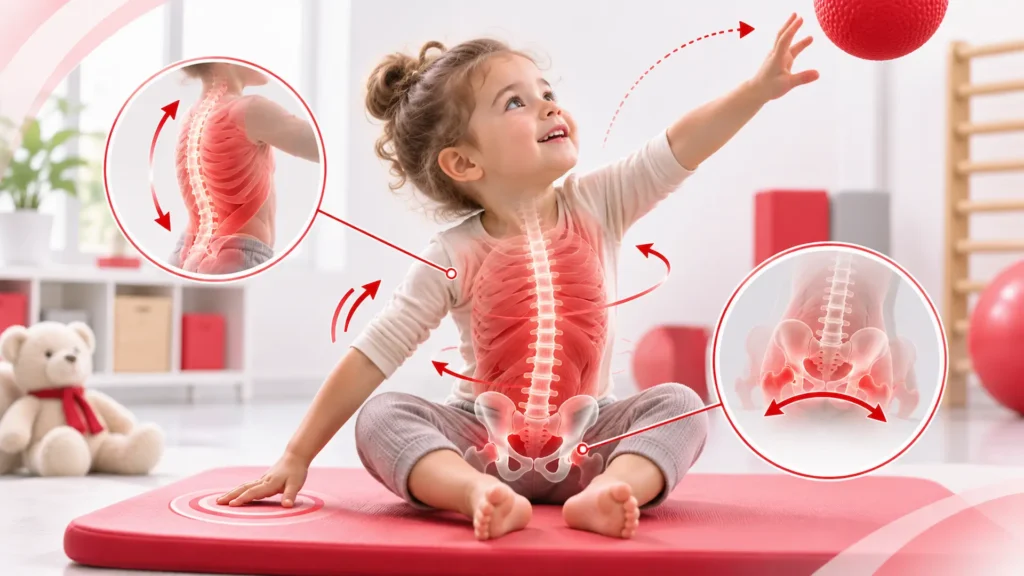
A child is sitting while a parent gently touches them with just one finger. There is no firm support or significant physical assistance, yet the child manages to maintain the sitting position. As soon as the parent removes their finger, the child becomes distressed, suddenly stiffens, or begins to lose balance.
Why can a child sit with barely any support, but not completely independently?
In children with cerebral palsy and other neurological or motor impairments, the answer often goes beyond muscle strength. The difficulty may lie in the child’s inability to generate sufficiently effective postural responses to control body movement when balance begins to shift.
Maintaining a sitting position while the body is stable is one thing. Controlling changes in body position before a fall occurs is something entirely different.
This is precisely why BDA therapy focuses not only on whether a child can sit, but also on how their body responds to changes in weight distribution, which postural reactions they use, and what prevents them from maintaining balance.
What Happens When a Child Begins to Lose Balance?
As babies develop the ability to sit independently, they learn not only to maintain an upright position but also to control their bodies when their balance shifts. They gradually develop postural responses that allow them to adjust their position, slow down the loss of balance, or protect themselves during a fall.
For example, when a baby leans to the right, the trunk and spine adjust their position, the pelvis and legs redistribute pressure against the supporting surface, and the hand may provide additional support when needed.
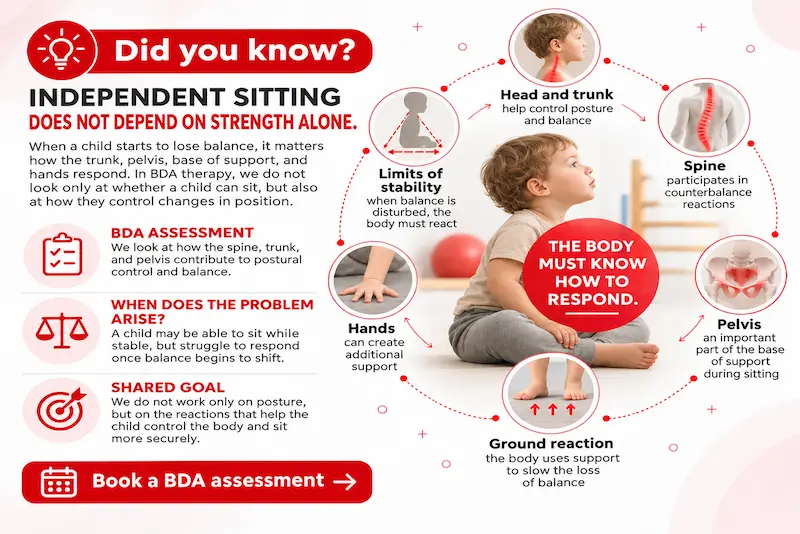
Every body has certain limits of stability the range within which the center of gravity can shift while balance is maintained without additional support.
In children with cerebral palsy, these limits may be reduced. A child may be able to sit while their trunk remains relatively still, but as soon as they lean further, they may be unable to generate an appropriate response and begin to fall suddenly.
This may result from restricted spinal mobility, insufficient muscle coordination, or difficulty effectively using the base of support.
The challenge, therefore, is not simply maintaining a sitting position, but also the child’s inability to control the loss of balance.
This is why, in BDA therapy, we assess how the spine, trunk, and pelvis contribute to postural control, which postural responses are limited, and what prevents the child from effectively using their own base of support.
Based on this assessment, we establish individualized therapeutic priorities.
Why Does BDA Therapy Place Special Emphasis on Counterbalance Reactions?
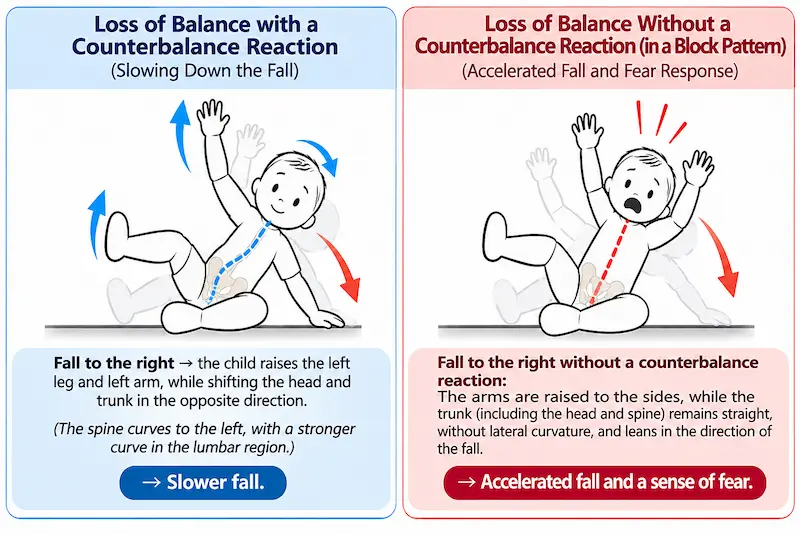
When a child begins to lean in one direction, other parts of the body can adjust their position to help maintain balance. In the BDA approach, these responses are referred to as counterbalance reactions. For example, if a child begins to lean to the right, an appropriate adjustment of the trunk to the left can help control the center of gravity and slow down further movement.
For this response to occur, the spine needs sufficient mobility, and the nervous system must be able to activate and coordinate the necessary muscles at the right time. However, in children with cerebral palsy, mobility in certain segments of the spine may be restricted, while muscle activation may lack sufficient selectivity or coordination. As a result, the body has fewer options for adjusting its position when balance begins to shift.
In BDA therapy, we therefore assess not only the position of the spine while the child is sitting, but also its ability to contribute to postural control and movement.
During the assessment, we examine the mobility of individual spinal segments and how they interact to identify potential biomechanical restrictions. Based on these findings, we determine which structures and postural responses should be prioritized in the therapeutic program.
This is one of the reasons why BDA treatment for a child who has difficulty sitting may involve working on spinal mobility, even when the child is not in a sitting position during the treatment.
How Do the Pelvis and Supporting Surface Help a Child Maintain Balance?
When a child sits, their body transfers weight to the supporting surface through the pelvis, thighs, and other areas of contact. At the same time, the surface exerts an opposing force on the body. In biomechanics, this is known as the ground reaction force. This force plays an important role in maintaining posture. However, simply being supported by a surface is not enough. What matters is how the child uses that support.
As the body leans, the distribution of pressure through the pelvis and legs changes. Through appropriate muscle activation and adjustments in body position, the child can influence the forces acting on the body and thereby help maintain balance. In children with cerebral palsy, this ability may be limited. For example, a child may sit with more weight distributed on one side of the pelvis but struggle to adjust their weight distribution appropriately when they begin to lose balance. Another child may have sufficient pelvic mobility but be unable to coordinate pelvic movement with trunk activity.
During a BDA assessment, we therefore analyze how weight is transferred through the pelvis, how the pelvis interacts with the spine, and whether biomechanical restrictions interfere with postural responses. If a child cannot effectively use their base of support, the underlying problem may not be limited to the part of the body that visibly leans.
How Does BDA Therapy Approach the Development of Independent Sitting?
When a child is unable to sit independently, parents may naturally assume that therapy will primarily involve repeatedly practicing the sitting position. However, in the BDA approach, we first seek to identify which postural responses are absent or insufficiently effective and what is limiting the child’s ability to perform them.
If a child cannot adequately adjust their trunk when losing balance, the therapist examines the biomechanical conditions necessary for that response. If the child has difficulty redistributing weight through the pelvis, the therapeutic priority may be different. When restrictions are present in multiple body segments, the treatment program is adapted to their interactions and the child’s functional needs.
This is why BDA treatment may not initially resemble the specific motor skill we aim to develop. Through individually selected biomechanical stimulation, BDA therapy aims to address the structures and mechanical conditions that may restrict postural responses. Within the BDA approach, particular attention is given to connective tissues, mobility, and the biomechanical relationships between different body segments.
The purpose of this work is not simply for the therapist to externally position the child in a desired posture. Instead, the goal is to create more favorable conditions for the child to develop and use their own motor responses. The BDA concept places particular emphasis on spontaneous postural responses reactions that the body uses without requiring the child to consciously think about every individual movement.
This is especially important for balance, as everyday movement does not allow us to consciously plan each adjustment of the spine, pelvis, or arms in advance. However, it is important to distinguish the goals of BDA therapy from the outcomes an individual child may achieve. The development of spontaneous postural responses depends on the child’s neurological, motor, and other individual abilities.
What Does Progress Look Like If a Child Is Not Yet Sitting Independently?
For a child with significant motor difficulties, progress does not necessarily mean achieving fully independent sitting right away. Sometimes, the first improvements can be observed in how the child responds to changes in body position. For example, a child who previously lost balance suddenly may now be able to adjust their trunk position in a more controlled manner. Another child may demonstrate better head control, distribute weight more evenly through their base of support, or move an arm without immediately losing balance.
For some children, progress may also mean needing less physical assistance during activities. These changes can be meaningful because they reflect how the child uses their body, rather than simply how long they can maintain a particular position.
However, their significance should be confirmed through repeated assessments and ongoing monitoring of functional abilities. For one child, the goal may be to develop independent sitting. For another, due to the severity of neurological and motor impairments, the priority may be safer, more stable sitting with appropriate support, improved head control, or greater ability to use their hands. This is why, in BDA therapy, each treatment plan is tailored to the child’s individual condition, abilities, and needs.
Why Does a BDA Therapist Work on the Spine and Pelvis When a Child Has Difficulty Sitting?
Because the spine and pelvis play an important role in maintaining balance. Their mobility, the way they interact, and their ability to adapt to changes in weight distribution influence how effectively a child can control their posture.
BDA therapy aims to identify restrictions in these structures and develop an individualized treatment program based on the child’s specific needs.
Why Is My Child Unable to Use Their Hands to Protect Themselves When They Begin to Fall?
Protective reactions require proper coordination and timely muscle activation. In children with cerebral palsy, these reactions may be delayed or limited. It is also important to assess how the trunk and pelvis contribute to controlling body movement before a fall occurs.
Can BDA Therapy Help a Child Develop Independent Sitting?
Improving head, trunk, and pelvic control, as well as postural responses, is among the therapeutic goals of the BDA approach. Based on a detailed assessment, an individualized treatment program is developed to address the child’s specific condition and needs.
Progress varies from child to child, and the ability to achieve independent sitting depends on multiple factors. Therefore, this outcome cannot be guaranteed in advance.
Can Fear Be a Reason Why a Child Cannot Sit Independently?
Fear can make it more difficult for a child to maintain postural control. However, in some children, fear may develop as a result of previous experiences of sudden and uncontrolled loss of balance.
This is why it is important to assess the child’s postural responses rather than assume that the difficulty is purely psychological.


