


Why, in BDA, doesn’t walking development begin with the step itself?
When we watch a child taking steps during therapy, it is natural to focus first on what we can see: whether the child took a step, how far they moved, and how much assistance they needed.
But walking does not happen only in the legs.
The moment a child places their weight on one foot, the change is not limited to that leg. The pelvis must respond to the load, the spine must adapt to the change in pelvic position, the trunk must respond to the shift in the centre of gravity, and the head needs to remain stable enough for the child to continue the activity.
A single step is, in fact, a whole-body response to a change in load.
This is exactly where BDA therapy begins.
We do not view the body as a collection of separate parts
The BDA approach views the body as a system of interconnected segments functioning as one mechanical whole. This way of thinking is closely related to the concept of biotensegrity a model in which stability and movement do not arise solely from the action of individual muscles or joints, but from the relationship between tension and compression throughout the entire structure.
The connective tissue system also plays an important role in this process. Fascial structures connect different regions of the body and provide one of the pathways through which forces can be transmitted between the trunk, pelvis and limbs.
This means that when a child places weight through one leg, the response should not remain “trapped” only in that leg or in the pelvis. A change in load creates a demand for the whole body to adapt.
In a more efficient response, force is distributed across several body segments. The pelvis, spine, rib cage and trunk all contribute to adapting the body’s position as the centre of gravity shifts in relation to the base of support.
This is where body geometry becomes especially important.
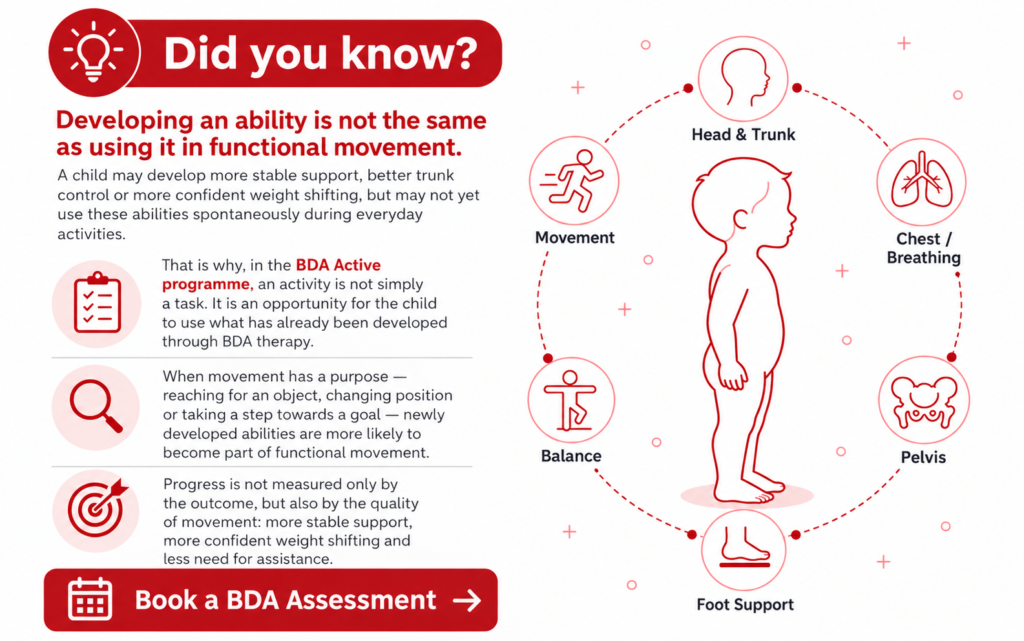
Why are body shape and physiological curves important?
The spine is not a straight, rigid column. Its physiological curves, the relationship between the pelvis and the spine, and the position of the rib cage all influence how the body receives and transmits load.
Through his “spinal engine” concept, Serge Gracovetsky emphasised that the spine is not simply a passive structure carried by the legs during walking. In his biomechanical model, movement of the spine, pelvis and legs is interconnected, while the lumbodorsal fascia contributes to force transmission between the lower and upper parts of the body. In his later work on the lumbodorsal fascia, Gracovetsky also highlighted the importance of lumbar lordosis in distributing load between the muscular and fascial systems.
For BDA, this idea is important for one practical reason: the shape of the body influences how forces can be transmitted when the child is placed under load.
That is why it is not enough simply to place a child on their feet and ask them to take a step. Before that, we want to see what actually happens throughout the body when the load is introduced.
What happens when the body does not produce an effective whole-body response?
In children with cerebral palsy and other developmental difficulties, we often see that the body does not respond evenly to changes in load. Gait studies in children with cerebral palsy have shown associations between changes in the position of the spine, pelvis and trunk and deviations in walking patterns. These may include greater changes in pelvic obliquity, pelvic tilt and trunk movement.
We can see this very clearly when a child shifts their weight onto one leg. Instead of the load being gradually transferred through the foot, leg, pelvis, spine and the rest of the body, the pelvis may move suddenly into a pronounced lateral tilt. The trunk then attempts to compensate for this change, while the child uses additional effort to remain in position.
The task may still be completed. The child may remain standing on one leg or even take the next step.
But in BDA therapy, the question we ask is not only: “Did the child succeed?” It is also: “How did the body manage the load we introduced?”
If a large part of the demand is repeatedly absorbed by the same segment, the child may develop highly effective compensatory strategies that allow the task to be completed — but this does not necessarily mean that the load is being distributed through the body in the way we want to encourage.
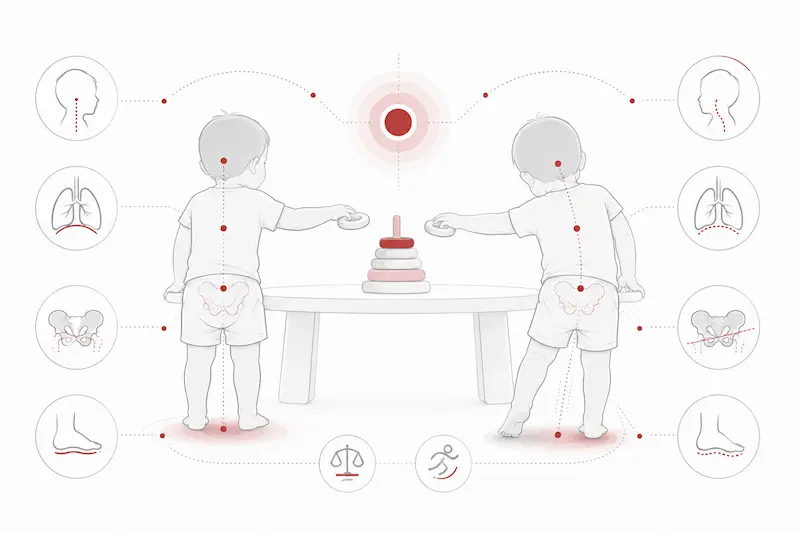
That is why BDA first looks for the weak point in the response
In many rehabilitation approaches, functional tasks, repetition and movement facilitation play an important role. BDA does not seek to challenge the value of this type of work. The difference lies primarily in where we place the focus at a particular stage of the therapeutic process.
Before asking the child for better performance, we want to identify the part of the system that is limiting the body’s response to load. This may involve a reduced ability of the rib cage to change shape during weight shifting, the relationship between the pelvis and the spine, limited movement within a specific spinal segment, the quality of foot support, or the way force is transmitted from the lower limbs towards the trunk.
Once such a point is identified, BDA stimulation is directed precisely towards it.
We do not immediately try to produce a “better-looking step.” We aim to change the conditions from which the body’s next response will emerge.
That is an important distinction.
From precise stimulus to spontaneous response
When the load on the body changes, the response to that change needs to occur quickly. In everyday life, a child does not have time to think with every step: “Now I will stabilise my pelvis, then move my trunk, then shift my weight, and then place my foot.” Movement does not function through constant verbal instruction.
The nervous system continuously uses sensory information about body position and load to adjust the next movement. Proprioceptive and other sensory input play an important role in adapting gait and planning the next motor response.
That is why, in BDA therapy, we follow the principle:
precise stimulus → body response → new experience of load.
The response to the stimulus is not a movement that the therapist “draws” for the child.
It should emerge from the child’s own body. During that response, the child may be given a task, asked to look at an object, reach for something, or follow a simple instruction, but the main goal is not for the child to consciously control every segment of the body.
We want the body to gain a different experience of how to respond to force and load.
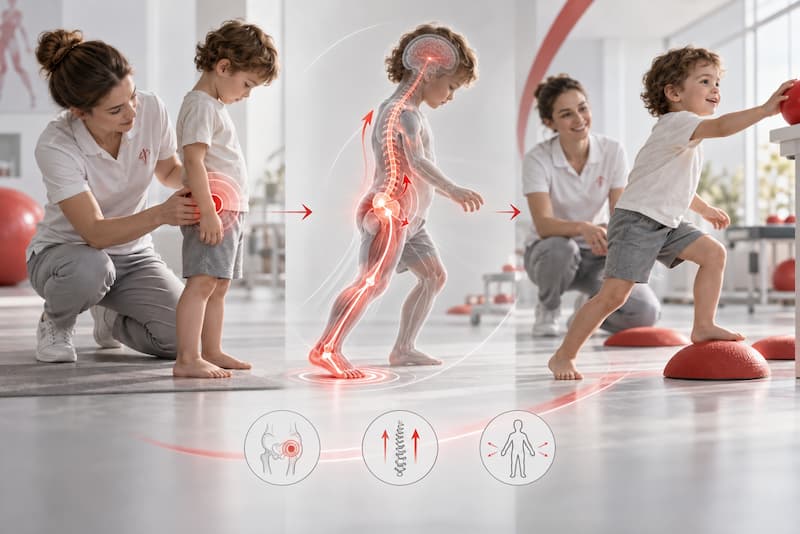
Where does BDA Active come in?
This is exactly where BDA Active takes on its full meaning.
Once we have worked through specific biomechanical limitations during BDA therapy, the child needs an opportunity to use those newly developed abilities in a situation where the body is actually being loaded.
But we do not simply return to the same task and say:
“Now walk correctly.”
The therapist chooses a position and activity that give the child the best opportunity to use what has previously been developed. If we want the child to transfer weight more effectively through one side of the pelvis, we set up the activity so there is a clear reason for that shift to happen. If we want the child to connect the pelvis and trunk more effectively during support, the position, height of support, object they want to reach for, and direction of movement can all be carefully selected to encourage that specific response.
The task is meaningful to the child, but biomechanically it is chosen with great precision by the therapist.
That is BDA Active.
Is it enough for a child to simply practise walking?
Not always. What matters is not only whether the child can take a step, but also how the body distributes load while doing so. If movement is repeatedly performed using the same compensatory strategies, repetition may reinforce that very pattern.
What does BDA therapy look for before working on the step itself?
It looks for the part of the system that most limits the body’s response to load. This may involve foot support, the pelvis, the spine, the rib cage, or the way force is transmitted through the body.
Does the therapist guide every movement during BDA therapy?
No. The aim is for a precise stimulus to elicit a response from the child’s own body. The therapist does not “draw” the movement for the child, but instead works to create better conditions for the body to find a more effective response on its own.
When is BDA Active introduced?
BDA Active is introduced when we want the child to use what has been developed through BDA therapy in a real activity — through support, weight shifting, changes in position, reaching, or taking a step.
In this way, a newly developed ability becomes connected to function rather than remaining limited to the therapy setting.


