


Every child develops at their own pace, but some signs deserve closer attention
One of the most common questions parents ask is: “Is my child developing as they should?” Watching a child grow and develop brings many joyful moments, but it can also raise questions and concerns. Parents often notice other children beginning to roll over, sit, crawl, or walk, and naturally wonder whether their own child is following a similar developmental path.
It is important to remember that children do not all develop at the same pace. Small differences between children are expected and are often a normal part of individual development. However, there are situations in which certain motor skills are delayed or develop in a way that may indicate the need for further assessment.
Recognizing early signs of motor development delays is not about looking for problems where none exist. Rather, it is about helping parents better understand when it may be beneficial to seek professional guidance and ensuring that a child receives timely support if needed.
What do we mean by motor development?
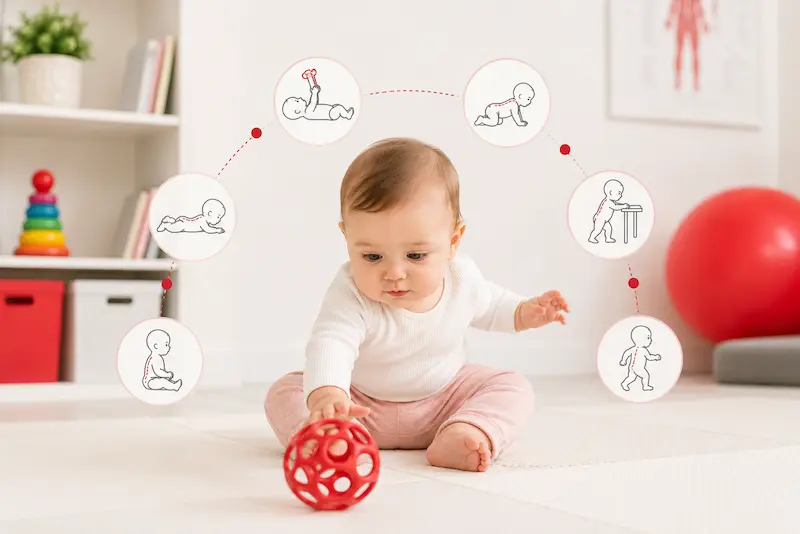
Motor development refers to a child’s ability to control body position, maintain balance, and gradually acquire increasingly complex movement skills.
During the first years of life, children progress through a series of important developmental milestones: including head control, weight-bearing through the arms, rolling over, sitting, crawling, standing, walking, running, and more advanced forms of movement.
While attention is often focused on whether a child has reached a particular developmental milestone, it is equally important to consider the quality of movement, overall body organization, and how the child uses their abilities in everyday activities.
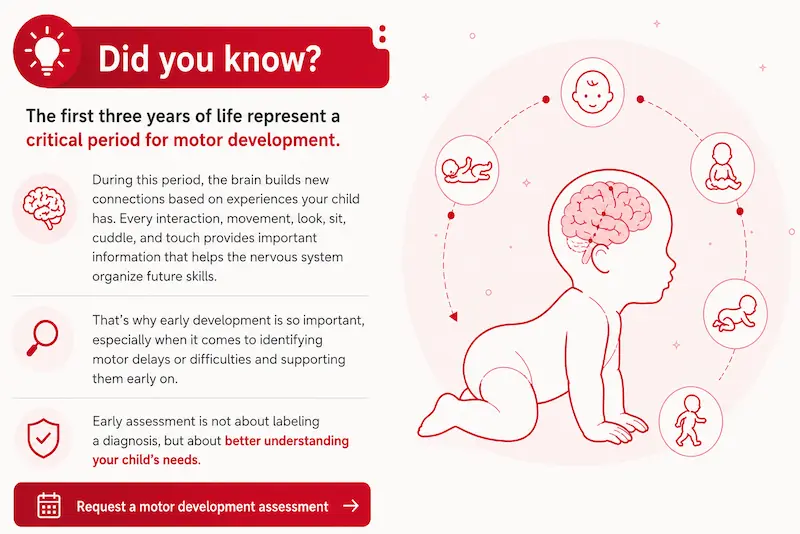
Why is it important to recognize potential difficulties early?
Early childhood development is a period of rapid nervous system maturation. During this time, the brain receives an enormous amount of information from the body and the environment every day, processes it, and builds new patterns of functioning.
For this reason, early assessment can play a significant role when there are concerns about a child’s development. Timely recognition of potential difficulties is not about making a diagnosis. Rather, it allows a child’s development to be evaluated objectively, helps identify any areas of concern, and, if needed, ensures that support is introduced at a time when it can have the greatest impact.
What early signs should parents pay attention to?
There is no single sign that, on its own, confirms the presence of a developmental problem. However, certain observations may indicate that a more detailed developmental assessment would be beneficial.
Poor head control
Head control is one of the first important motor skills a child develops. If a child has difficulty lifting or maintaining head control in different positions, appears unusually floppy, or struggles significantly to move and organize their body against gravity, it is advisable to consult a qualified professional.
Delayed or limited rolling
Rolling from back to stomach and from stomach to back is an important milestone in the development of body control. A child who shows little interest in changing positions or experiences significant difficulty when rolling may benefit from a more comprehensive assessment of their motor development.
Delayed sitting
Independent sitting allows a child to explore their environment, use their hands more effectively, and develop new skills. If a child is unable to maintain a stable sitting position independently or requires substantial support to sit, it is important to look at the broader picture of their motor development.
Limited crawling or a lack of interest in movement
Not all children crawl in the same way, and some may skip this stage altogether. However, it is important to observe whether a child shows a desire to move through their environment, explore their surroundings, and find ways to reach desired objects or destinations. A lack of initiative to move and explore can provide valuable information during a developmental assessment.
Delayed standing and walking
Taking first steps is a significant developmental milestone. When walking develops more slowly than expected, or when a child demonstrates noticeable difficulties with balance, stability, and body control, a professional assessment can help provide a clearer understanding of their developmental needs.
Favoring one side of the body
Parents sometimes notice that their child uses one hand or one side of the body much more frequently than the other. While certain preferences can be a normal part of development, a pronounced asymmetry in movement deserves closer attention.
Frequent falls and balance difficulties
In older children, frequent falls and instability during walking, running, or climbing may indicate challenges with movement organization, postural control, or the processing of sensory information received from the environment.
It is not only important what a child can do, but also how they do it
This is one of the most important aspects of motor development. Sometimes a child reaches a particular developmental milestone but relies on movement patterns that require significant additional effort and compensation. For example, a child may be able to sit independently but only with excessive leaning of the trunk. They may be able to walk, yet depend on compensatory movement patterns that make movement less efficient.
For this reason, developmental assessment involves more than simply determining whether a specific skill is present. It also requires understanding how the body organizes movement. The quality of movement organization often provides some of the most valuable insights into a child’s developmental needs.
When is it time to seek a professional assessment?
Many parents postpone an assessment because they are unsure whether there is a reason for concern. It is important to understand that an assessment does not mean that a problem exists. Rather, it provides an opportunity to gain objective information about your child’s development, address any concerns, and receive guidance on monitoring progress or providing support when needed.
If you feel that your child’s development is not following the expected course, or if you notice difficulties with movement, balance, or motor organization, consulting a qualified professional can help you gain a clearer understanding of the situation. Parental intuition is often an important signal and should not be overlooked.
Every child follows their own developmental journey
Motor development is not a competition, and there is no single child who serves as the standard for all others. However, recognizing potential difficulties early can have a significant impact on the quality of support a child receives.
By observing development, understanding early warning signs, and seeking timely assessment, parents are better equipped to make informed decisions and provide their child with the best possible opportunities for progress. When there is uncertainty, a professional assessment is often the most effective way to gain clarity.
Does every delay mean there is a developmental problem?
No. Children develop at different rates, and minor variations are often a normal part of typical development. However, if there are concerns about a child’s development or if there is a more significant deviation from expected developmental patterns, a professional assessment is recommended.
Is it a problem if a child does not crawl?
Not all children go through the crawling stage in the same way, and some may skip it altogether. What matters most is not whether a specific developmental stage is present, but how the child organizes movement, uses their body, and explores their environment.
When should I seek a professional assessment?
If you notice delays in the development of motor skills, difficulties with balance, movement organization, or simply have concerns about your child’s development, a professional assessment can provide clearer guidance and help you better understand your child’s developmental needs.
Should I wait, or should I consult a professional right away?
When there is uncertainty, a professional assessment is often the best way to gain clarity. An early assessment does not mean that a problem exists; rather, it provides an objective evaluation of a child’s development and helps parents receive professional guidance on monitoring progress and determining whether any additional support may be beneficial.


