


Two children may have the same diagnosis and yet display entirely different patterns of posture, movement, and body use in everyday activities. One child may have more pronounced difficulties with head and trunk control. Another may be able to maintain a position more steadily, but still show asymmetry, limited mobility, or require significant additional effort. For some children, the greatest challenge may be establishing stable support; for others, it may be weight transfer, while another child may experience difficulties related to the organization of the ribcage, spine, and pelvis.
For this reason, a diagnosis alone is not enough to determine the goals and content of the therapeutic process.
The BDA therapeutic approach begins with a detailed assessment of each child as an individual. It considers the child’s physical characteristics, existing abilities, the way they organize posture and movement, the compensations they use, and the demands they encounter in everyday life.
A diagnosis is important, but it does not tell the whole story
A diagnosis provides important information about a child’s health. It can help us understand potential difficulties, risk factors, and the need for ongoing medical monitoring.
However, the diagnosis alone does not show how an individual child functions. It does not tell us how the child controls their head and trunk; how they establish and use support; whether they engage both sides of the body evenly; how they transfer weight from one position to another; how much additional effort they use during movement; which compensatory patterns they rely on; how much support they need; or how they apply their abilities in everyday activities.
A diagnosis is therefore an important starting point, but an individualized therapy plan is not based solely on its name. It is developed according to what is observed during the assessment of the individual child—their abilities, difficulties, body organization, and functional needs.
The goal is not to apply the same programme to every child with the same diagnosis, but to understand what each child needs in order to use their body with greater stability and efficiency, and with less unnecessary effort.
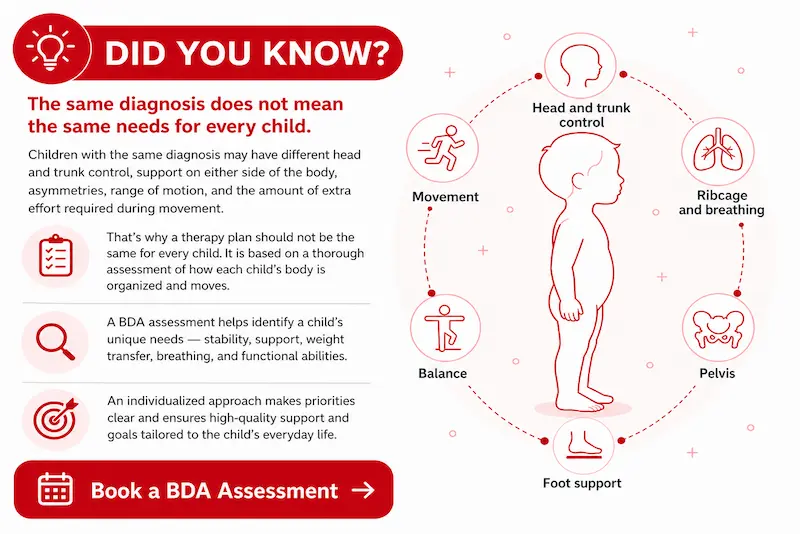
BDA therapy does not begin with choosing an exercise
Parents often want to know which exercises are best for a particular diagnosis. However, before selecting an exercise, it is necessary to understand how the individual child organizes their body, posture, and movement.
BDA, or the Biomechanical Developmental Approach, does not focus only on the end result—for example, whether a child can sit, stand up, or perform a particular movement. Attention is also given to how different parts of the body work together while the child carries out an activity.
During the assessment, the following are observed: head position and control; organization of the neck and shoulder girdle; the position, shape, and mobility of the ribcage; the relationship between the spine and pelvis; trunk stability and mobility; how the child establishes and uses support; weight transfer; breathing during different positions and activities; and any asymmetries or compensatory patterns that may be present.
These elements do not function independently. A change in one part of the body can affect overall stability, support, breathing, and movement quality.
The purpose of the assessment is therefore not simply to determine whether a child can perform a particular activity. It is important to understand how the child performs it, how much effort is required, which parts of the body are involved, and what kind of support is needed to make the movement more stable, efficient, and functional.
Only after such an assessment are therapeutic goals, positions, activities, and exercises selected to meet the needs of the individual child.
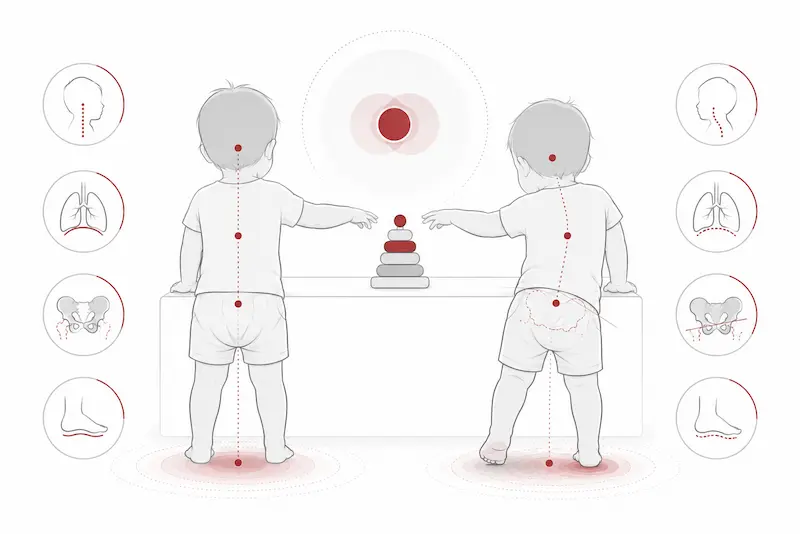
What are the benefits of an individualized BDA approach?
Clearer identification of therapeutic priorities
A detailed assessment helps identify what is currently limiting the child’s function the most and where therapeutic work should be focused first. The difficulty that is easiest to notice may not always be related only to the part of the body where it appears.
For example, limited movement of an arm or leg may be connected to head position and control, trunk stability, ribcage organization, the relationship between the spine and pelvis, or the quality of support.
Therapeutic priorities are therefore not determined solely by where the difficulty is observed, but by understanding how the body as a whole organizes posture and movement.
More effective use of existing abilities
The BDA approach does not focus only on what a child is not yet able to do. It is equally important to recognize the abilities the child already has and to understand the conditions in which they can use those abilities more steadily and functionally.
When provided with an appropriate position, stable support, and the right level of assistance, a child may sometimes demonstrate abilities that are less visible in other circumstances. They may be able to use their hands more freely, transfer weight more easily, maintain a position for longer, or perform an activity with less assistance and additional effort.
This does not mean that the ability has appeared suddenly. Rather, better conditions have been created for the child to use the abilities they already have.
Reduced unnecessary effort
When the body does not have a sufficiently stable and adaptable foundation for movement, a child often uses additional strategies to complete the desired activity. These may include lifting the shoulders, throwing the head backwards, holding the breath, stiffening the legs, relying heavily on the arms for support, or using momentum.
These compensatory strategies may help the child complete the movement, but they often require more energy and limit freedom and adaptability during the activity. Individually tailored therapy does not focus only on the visible compensation, but also on understanding why the child uses it. The aim is to create better conditions for stability, support, and movement organization.
The goal is not to eliminate every additional movement immediately, but to help the child gradually find a more efficient and less demanding way to use their existing abilities.
More precise monitoring of changes
Progress is not reflected only in the development of a new skill. Important changes are often first observed in the way a child organizes their body and performs activities they can already do.
These changes may include: more stable head and trunk control; better-quality and more secure support; easier weight transfer; more balanced use of both sides of the body; less additional effort and fewer compensations; greater mobility; the ability to maintain a position or activity for longer; and a reduced need for assistance.
For example, a child may not yet have developed a new function, but may be able to sit for longer, use their hands more freely, change position more easily, or perform the same activity with less effort.
A new functional skill is often the most noticeable result of the therapeutic process. However, changes in stability, mobility, support, and body organization are equally important, as they provide the foundation for the child to use both existing and future abilities more effectively, efficiently, and independently.
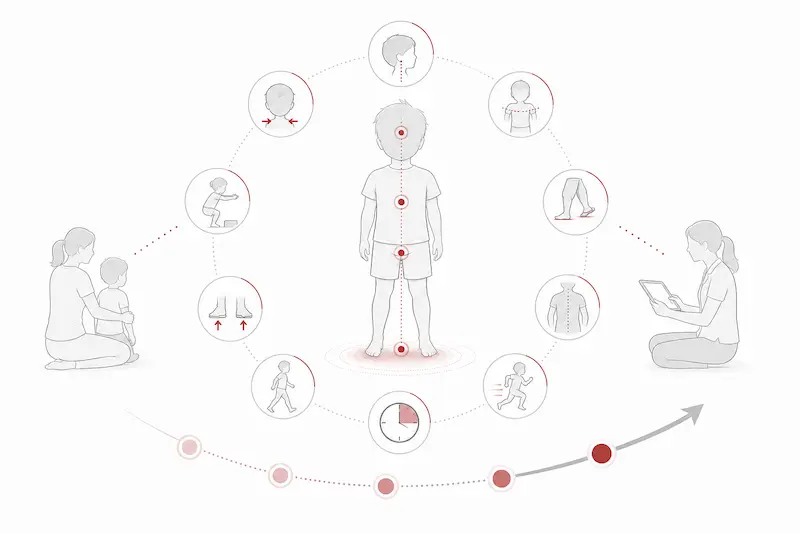
Do all children with the same diagnosis have the same motor difficulties?
No. Children with the same diagnosis may differ significantly in head and trunk control, mobility, support, asymmetry, fatigue, and level of independence. For this reason, the therapy plan should be tailored to the needs of the individual child.
Why isn’t my child doing the same exercises as another child?
Because exercises are selected according to each child’s individual abilities, needs, and goals. The same diagnosis does not mean the same movement patterns, so the therapy plan cannot be identical for every child.
Does the BDA therapy plan change over time?
Yes. The therapy plan is adjusted in response to changes in body organization, the development of new abilities, the child’s growth, and their needs in everyday activities.
When is a BDA assessment useful?
An assessment is useful when you want to gain a clearer understanding of how your child organizes their body and movement, what is currently limiting their functional abilities, and what type of support may best meet their individual needs.


