

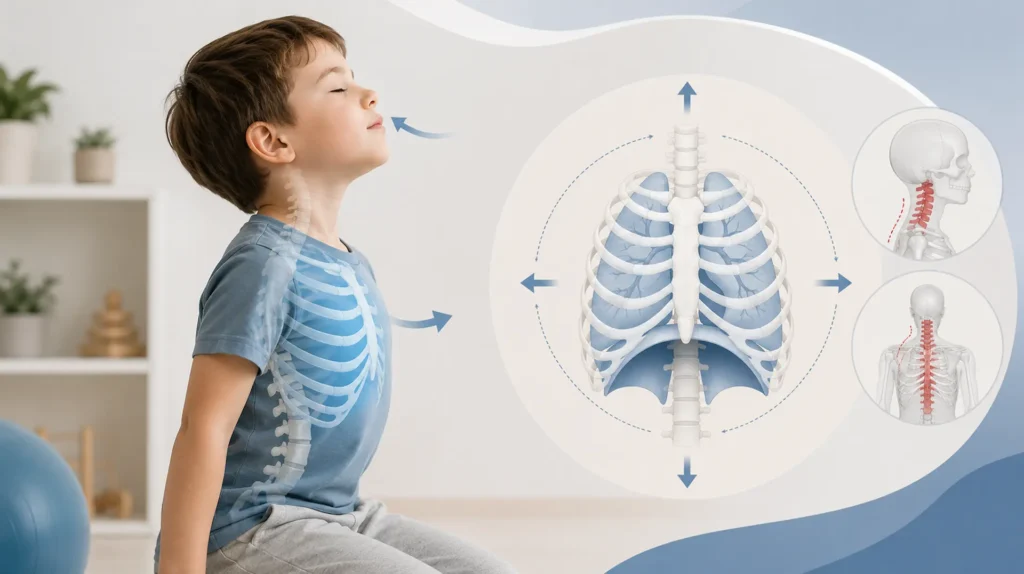
Have you ever noticed that your child raises their shoulders while breathing, has difficulty sitting without support for extended periods, frequently leans their head forward, or tires more quickly than expected?
At first glance, these signs may seem unrelated. One appears to involve breathing, another posture, and another balance or movement. However, the body does not function as a collection of separate parts. In children especially those with motor or developmental challenges the way the rib cage is organized can play an important role in how they breathe, sit, stand, use their arms, and maintain stability.
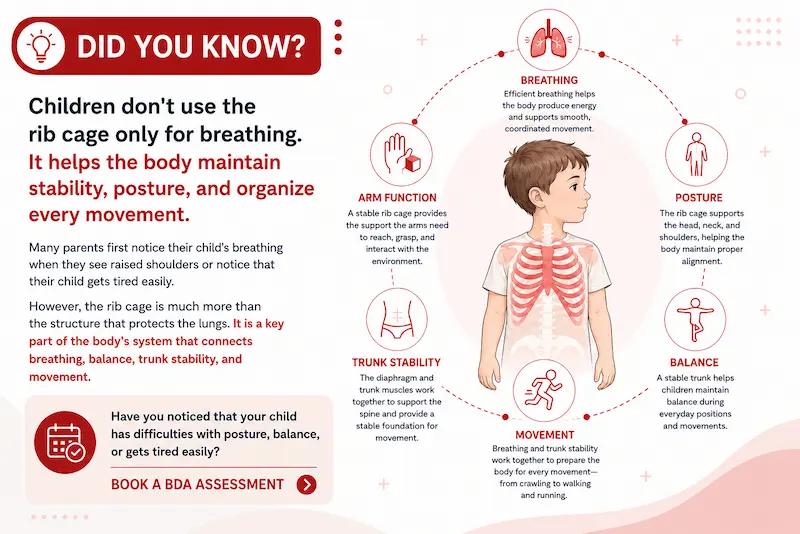
The rib cage is important for much more than protecting the lungs and heart. It is one of the body’s central structures, connecting breathing, posture, and movement. When the rib cage provides effective support, the body can distribute forces more efficiently, maintain alignment, and use energy for functional activities. When that support is limited, children often develop alternative movement strategies to accomplish the same task.
Why Is the Rib Cage More Than Just a “Breathing Structure”?
When we think about the rib cage, the first thing that usually comes to mind is the lungs. That’s understandable, since the movement of the rib cage is essential for breathing. However, its role extends far beyond respiration.
The rib cage is connected to the spine, shoulders, neck, diaphragm, abdominal muscles, pelvis, and the fascial structures that link different parts of the body. Because of these connections, every breath is more than just a respiratory process it is also part of the body’s overall postural organization.
When a child inhales, the ribs move, the diaphragm changes position, the trunk responds, and the body makes subtle adjustments to maintain stability. As the child exhales, the body reorganizes pressure and muscle activity once again. This continuous rhythm takes place all the time, even when the child is completely still.
In other words, breathing is not separate from posture. It is an essential part of how the body organizes and supports itself in space.
How Does the Rib Cage Influence Posture?
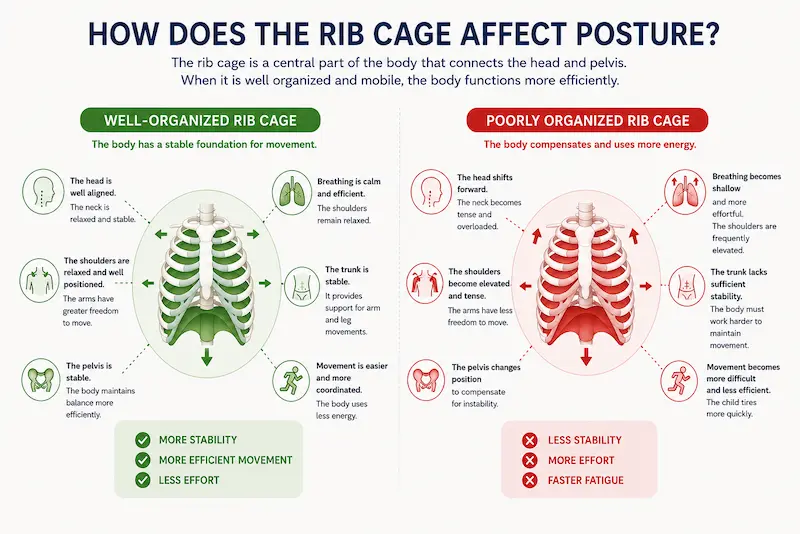
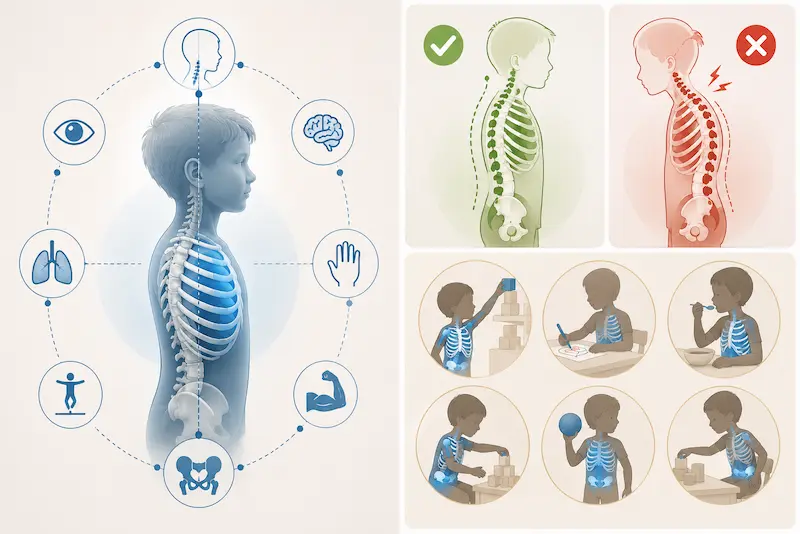
Posture is much more than simply “standing up straight.” It is the way the body organizes itself in relation to gravity, support, and movement. Good postural organization allows a child to sit, stand, look around, turn, use their arms, breathe, and respond to changes in position. The rib cage plays an important role in this process because it sits between the head and the pelvis. It serves as a central structure through which forces and movement are transferred between the upper and lower parts of the body.
When the rib cage is overly rigid, collapsed, rotated, asymmetrical, or held in a constant state of tension, the rest of the body often has to adapt. The head may shift forward, the shoulders may become elevated, the neck may become tense, and the pelvis may change its position. The arms may lose the stable foundation they need for efficient movement, and walking may appear less coordinated. Parents often notice only the result: their child leans to one side, has difficulty sitting, walks differently, tires quickly, or appears stiff. However, the underlying cause is not always where the difficulty is most visible.
The Rib Cage and Head Position
Head position is often one of the first things parents notice. A child may consistently hold their head forward, tilt it to one side, or have difficulty maintaining a stable head position while sitting or playing. Although it may seem like the issue is limited to the neck, the head rarely functions independently of the rest of the body. For the head to remain stable, it needs support from the trunk and the rib cage is an important part of that support.
When the rib cage does not provide a stable foundation, the neck often has to work harder. As a result, a child may appear to be constantly “holding up” their head using the muscles of the neck. This can be physically demanding and may affect attention, visual focus, feeding, communication, play, and the effective use of the arms. For this reason, the BDA approach does not assess head position in isolation. Instead, it looks at how well the head is supported by the rib cage, trunk, and pelvis as part of the body’s overall organization.
Rib Cage and Trunk Asymmetry
Some parents notice that one side of their child’s body appears more active, more stable, or “stronger” than the other. A child may rely more on one arm for support, turn more easily to one side, sit with a noticeable lean, or show visible differences in the position of the shoulders or rib cage.
Asymmetry does not always indicate a problem. However, when it is pronounced and consistently present in different positions and activities, it can affect how a child uses their body. If one side of the rib cage is more mobile or provides better stability than the other, the child may begin to develop movement patterns that rely more heavily on that side.
This can influence sitting, rolling, crawling, walking, arm function, and balance. That is why a professional assessment looks beyond whether a child can perform a movement it also evaluates how the movement is performed, including whether it is symmetrical, efficient, and supported by good overall body organization.
The Rib Cage, Breathing, and Speech Development
Breathing is important for much more than posture and movement. It also plays a role in feeding, voice production, speech, and the regulation of activity. Trunk stability and the organization of the rib cage can influence how efficiently a child uses their breath for vocalization, speech production, and sustained communication.
This does not mean that every speech difficulty is related to the rib cage. Speech is a complex function that depends on many different systems working together. However, in children with motor and postural challenges, it is valuable to consider the foundation that supports speech breathing, head position, trunk stability, and the organization of the oral structures.
For this reason, a multidisciplinary approach is often especially valuable. When the body is viewed as an integrated whole, it becomes easier to understand why a child performs certain functions with greater effort and where additional support may be needed.
Does poor posture always mean there is a problem with the rib cage?
No. Posture is influenced by many factors, including muscle tone, balance, strength, coordination, movement habits, sensory processing, and neurological development. However, the rib cage can play an important role in postural stability, which is why it is worth assessing when a child has persistent difficulties with posture, tires easily, or shows recurring movement challenges.
Can the way a child breathes affect their movement?
Yes. Breathing, the diaphragm, the rib cage, and the trunk are all functionally connected. When a child has to use excessive effort to breathe, it can affect postural stability, head and neck alignment, shoulder position, and the overall quality of movement.
Can breathing exercises improve posture?
Not on their own. For children with motor and developmental challenges, it is important to consider the body as a whole. Breathing is just one part of a larger system that includes the rib cage, spine, pelvis, shoulders, head, and movement. That is why every therapeutic approach should be individualized and based on the child’s specific needs.
When should you seek a professional assessment?
A professional assessment is recommended if you notice that your child has difficulty sitting, maintaining balance, breathing during physical activities, tires easily, shows trunk asymmetry, or consistently relies on compensatory movement patterns. An early assessment does not necessarily mean that there is a problem. Instead, it helps provide a clearer understanding of your child’s development and identifies whether additional support may be beneficial.


