

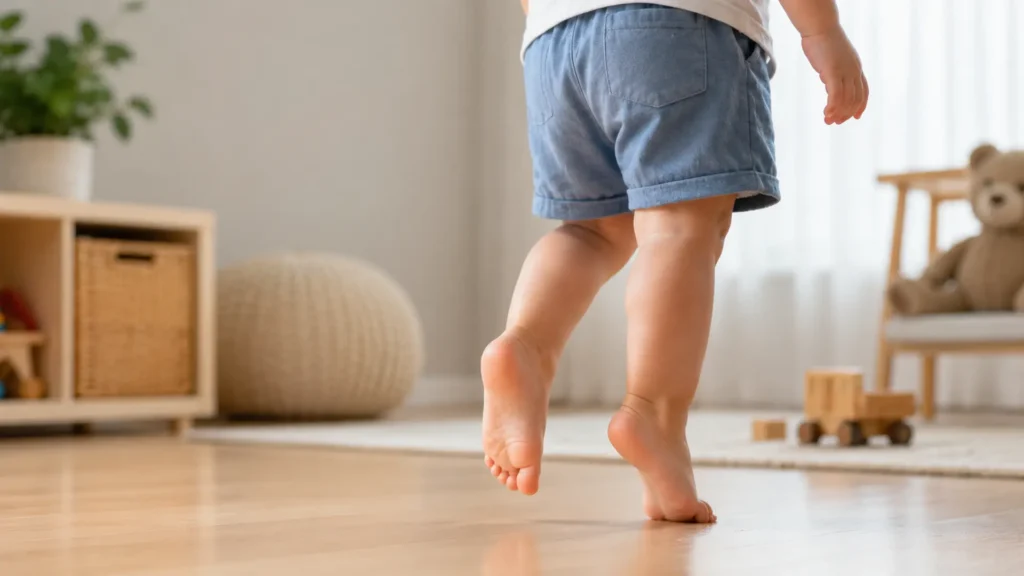
Many parents are surprised when they notice that their child walks without placing their heels on the ground, relying instead almost entirely on their toes. In some cases, this occurs only occasionally during play or moments of excitement, while for other children it becomes a consistent pattern present in almost every step.
When parents first notice toe walking, they are often unsure whether it is simply a temporary stage of development or a sign that professional advice may be needed. This uncertainty is one of the most common reasons families seek a developmental assessment. It is important to understand that toe walking does not automatically indicate a developmental problem. For some children, it is part of typical development, while for others it may suggest the need for a closer look at how they organize movement and use their bodies during walking and other daily activities.
What does toe walking actually mean?
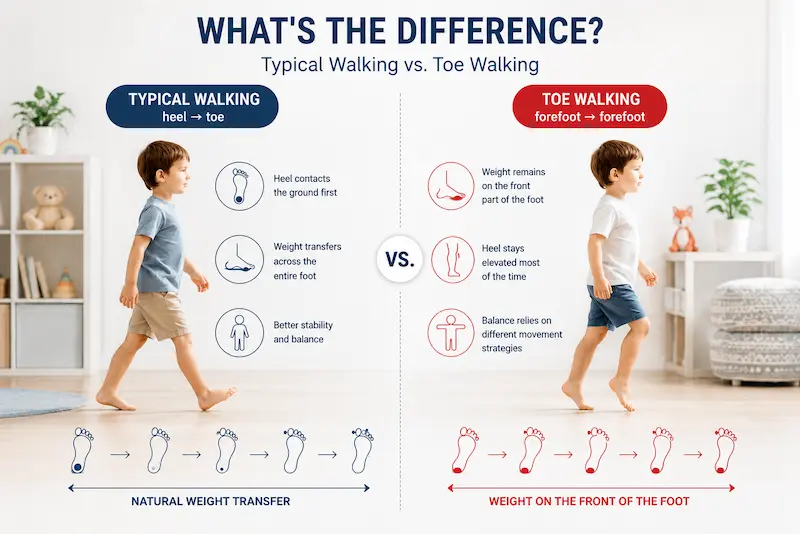
Toe walking refers to a movement pattern in which a child walks without placing their heel on the ground, or does so only rarely. In a typical walking pattern, the heel makes contact with the ground first, and body weight is then gradually transferred across the entire foot. When a child walks on their toes, this pattern looks different. Most of the body weight remains on the front part of the foot, which affects the way the body maintains balance and organizes movement.
Although parents most often notice the position of the feet, it is important to understand that walking is a complex activity that involves the entire body.
When can toe walking be part of typical development?
Occasional toe walking is not uncommon in children who have recently started walking. Young children explore different ways of moving, test their balance, and gradually develop more stable movement patterns. For this reason, it is not unusual for a child to walk on their toes from time to time during play, moments of excitement, or while exploring their environment. As motor control, balance, and postural stability continue to develop, most children naturally adopt a more mature walking pattern that involves using the entire foot.
Why do some children walk on their toes while others do not?
Every child develops movement patterns in their own way. The way a child organizes balance, transfers body weight, maintains stability, and uses their muscles during movement all influence their walking pattern. For some children, toe walking is simply a temporary stage of development. For others, it may be related to the way the body organizes movement, maintains balance, or distributes weight during walking.
This is why two children who walk on their toes may not have the same underlying reason for doing so. For that reason, it is not possible to draw conclusions based solely on the position of the feet. To understand why a child uses a particular walking pattern, it is important to consider how the entire body functions and works together during movement.
Toe walking is not just about the feet
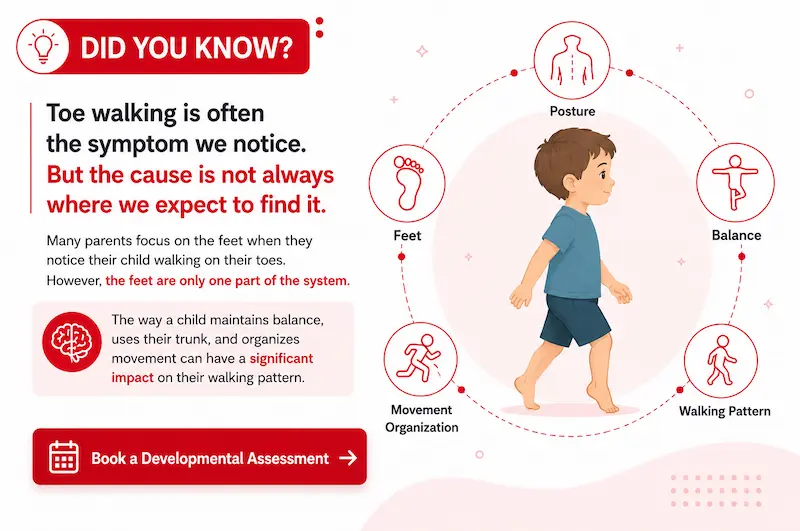
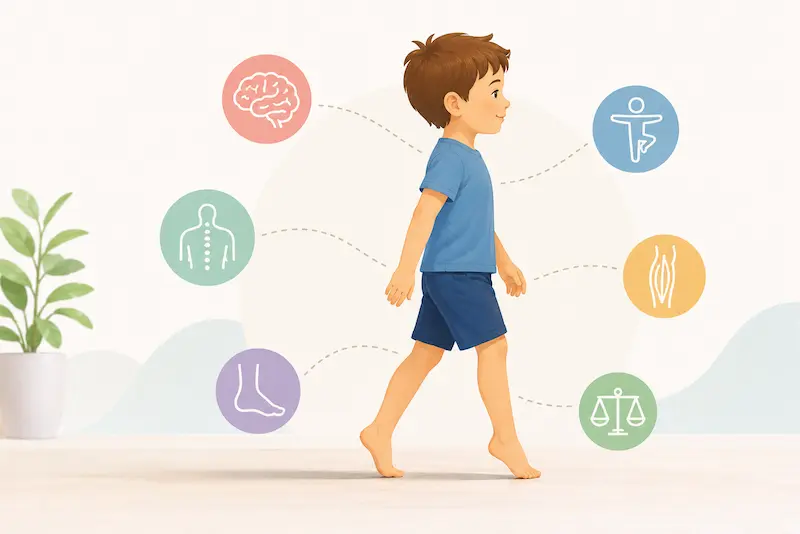
This is one of the most important things parents should understand. When a child walks on their toes, attention is often focused solely on the feet or ankles. However, the position of the feet is only one part of a much more complex system. For walking to be stable and efficient, different parts of the body must work together. Trunk stability, postural control, balance, and weight distribution all play an important role in the way a child organizes movement. This is why toe walking is often viewed as a movement pattern rather than simply an issue involving one part of the body.
Parents often notice toe walking only after looking back at older videos
Interestingly, many parents do not immediately realize how often their child walks on their toes. It is often only after reviewing older videos or photographs that they recognize the same pattern has been present for months. In some cases, toe walking appears only in certain situations, while in others it may be less noticeable. For this reason, it can be helpful to observe a child during a variety of activities—while walking, running, playing, or exploring their environment. Observing movement across different situations often provides a much clearer picture than a single moment that happens to catch a parent’s attention.
It is not only important whether a child walks, but how they walk
One of the most common misconceptions is that reaching a developmental milestone is all that matters. However, the quality of movement often provides information that is just as important as the skill itself. For example, a child may be able to walk independently, yet consistently rely on the front part of the foot, frequently lose balance, or use movement patterns that require significant extra effort.
At first glance, everything may appear to be fine simply because the child is walking. However, the way a child organizes movement often reveals much more about their motor development. This is why professionals do not focus solely on whether a particular skill is present during an assessment, but also on how the body achieves that movement.
When is it time to seek further evaluation?
Toe walking does not automatically mean that a child has a developmental problem. However, there are situations in which a professional assessment may be beneficial. Parents most often seek an evaluation when they notice that their child rarely places their heels on the ground, when the pattern remains unchanged over an extended period, or when toe walking becomes the child’s primary way of moving.
Additional attention may be warranted if: the child walks on their toes most of the time, the heels rarely make contact with the ground, the pattern persists for months without significant change, the child frequently loses balance or falls, there are delays in other motor skills, parents have concerns or questions about their child’s development.
An assessment can help determine why a particular movement pattern is present and whether any additional support may be beneficial.
Is it normal for a child to walk on their toes occasionally?
Yes. Occasional toe walking can be a part of typical development, especially in children who have recently started walking.
Will my child stop walking on their toes on their own?
For many children, toe walking gradually decreases as balance, stability, and motor control continue to develop. However, if toe walking persists over a longer period of time or becomes the child’s primary way of moving, it may be beneficial to seek a professional assessment.
Can toe walking affect the quality of walking?
If this movement pattern persists over a longer period of time, it may influence the way a child organizes movement, maintains balance, and uses their body during everyday activities.
Should I wait or schedule an assessment?
When there is uncertainty, an assessment is often the best way to gain clarity. An early assessment does not mean that a problem is present. Instead, it provides an objective evaluation of a child’s development and helps parents receive professional guidance on whether further monitoring or additional support may be beneficial.


